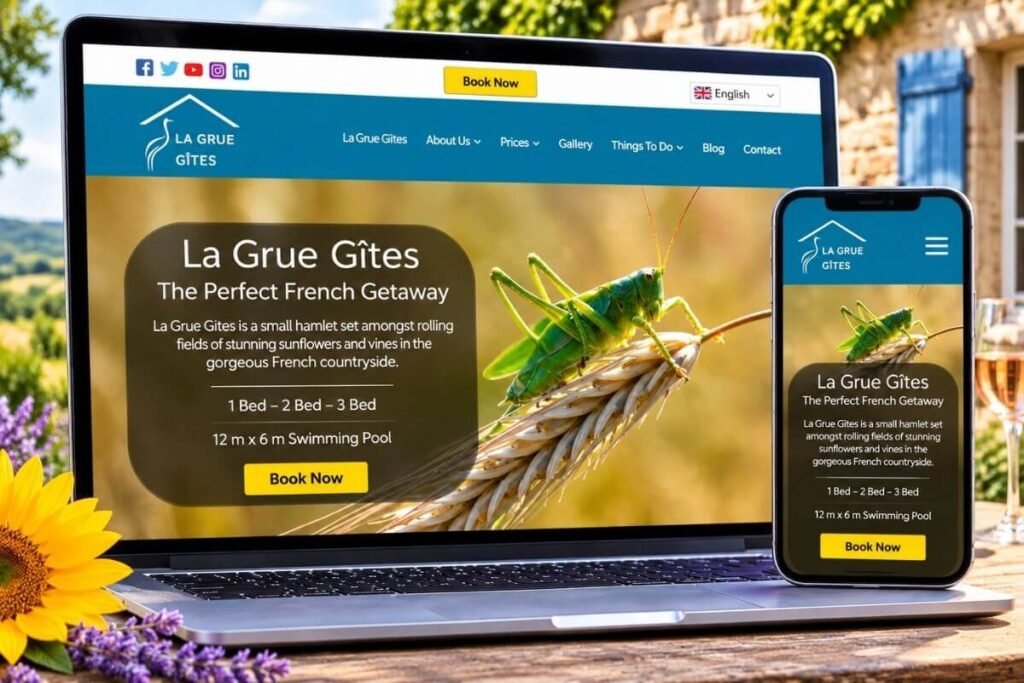
La Grue Gîtes provides holiday accommodation in France, giving visitors a base from which to enjoy the property and surrounding area. This holiday accommodation website design case study shows why an independent accommodation website needs to sell more than rooms, facilities and availability. It needs to help potential guests imagine the experience of staying there.
Choosing holiday accommodation is very different from choosing many other services.
Potential guests are making a decision about where they will spend part of their holiday.
They want practical information, but photographs, location, atmosphere and confidence in the accommodation can be equally important.
The website therefore needs to answer two questions at the same time:
Is this accommodation suitable for us?
And:
Would we actually like to stay here?
For La Grue Gîtes, the website provides somewhere to bring those two sides of the decision together.
Project Overview
Client: La Grue Gîtes
Sector: Holiday Accommodation & Tourism
Project: Holiday Accommodation Website Design
Services: Website Design, Website Content, Accommodation Information and Ongoing Website Support
Website: Visit La Grue Gîtes
The Holiday Accommodation Website Design Challenge
The main holiday accommodation website design challenge is balancing inspiration with information.
A website filled entirely with practical information may answer questions but fail to create any excitement about visiting.
A beautiful website with very little useful information can create the opposite problem.
Potential guests may like what they see but still be unsure whether the property meets their needs.
A good accommodation website needs both.
Visitors need to understand:
What is the accommodation like?
Where is it?
Who is it suitable for?
What facilities are available?
What is there to do nearby?
What does the surrounding area offer?
How do I find out more or make a booking?
The structure of the website needs to help answer those questions without making the visitor hunt for information.
Selling The Holiday Experience, Not Just The Property
One of the biggest differences with holiday accommodation website design is that the product extends beyond the property itself.
Guests aren’t travelling simply to spend their entire holiday inside the accommodation.
The destination matters too.
That means the website can help potential guests understand not only where they will stay, but what a holiday there might actually look like.
The accommodation is one part of the overall experience.
The surrounding towns, attractions, countryside, food, activities and places to visit can all influence somebody’s decision.
This gives an independent accommodation website an opportunity that is sometimes missed when the entire site is built around a booking calendar.
What Does A Holiday Accommodation Website Need?
Before thinking about search engines, the website needs to work for potential guests.
They need enough information to decide whether they want to investigate the accommodation further.
Depending on the property, that can include:
- Clear accommodation information
- Genuine photographs
- Facilities
- Location information
- Information about the surrounding area
- Places to visit
- Things to do
- Information for different types of guests
- Contact or booking information
- Reviews where available
- Practical information
- Mobile-friendly pages
The exact structure should reflect the property and the questions real guests are likely to ask.
This is where thoughtful website content writing becomes particularly useful.
The content shouldn’t simply fill space around photographs.
It should help somebody make a decision.
Using Photography In Holiday Accommodation Website Design
Photography is naturally one of the most important parts of a holiday accommodation website design.
Potential guests want to see where they might stay.
That means photographs can help communicate:
- The accommodation
- Bedrooms
- Living areas
- Outdoor spaces
- Facilities
- Character and features
- Views
- Surroundings
- The wider destination
For accommodation websites, images aren’t decoration.
They are part of the information.
A potential guest may use the photographs to decide whether a property feels spacious enough, whether the outdoor area suits their holiday or simply whether they can imagine themselves staying there.
The design therefore needs to give strong photographs enough space to work.
Helping Visitors Understand The Accommodation
Beautiful photographs still need useful information around them.
Potential guests may have very practical questions.
How many people can stay?
What facilities are available?
What is the layout?
What type of holiday might it suit?
Where exactly is it?
What is nearby?
These questions can be addressed through clear page structure and content rather than making somebody send an enquiry for basic information.
The more confidently a visitor understands the accommodation, the easier it becomes for them to decide whether it belongs on their shortlist.
Holiday Accommodation Website Design And The Destination
The surrounding destination is an important part of the La Grue Gîtes website.
Someone researching a holiday in France may initially discover the accommodation.
But before making a decision, they may also want to know what they can do once they arrive.
This creates an opportunity to build useful content around the local area.
Instead of simply saying that there are “lots of things to do nearby”, the website can provide genuine information.
That might include:
- Local towns
- Attractions
- Markets
- Restaurants
- Walking
- Cycling
- Family activities
- Historical places
- Day trips
- Seasonal events
This content helps potential guests while also creating additional context for search engines.
Creating Useful Content Around A Holiday Destination
Accommodation businesses have particularly good opportunities for useful website content.
Guests naturally ask questions before travelling.
Where should we visit?
What can we do with children?
Where can we eat?
What attractions are nearby?
What should we see during a week’s stay?
Those questions can become useful articles and guides.
This is exactly the type of content that can be developed through blog writing.
Instead of publishing generic articles purely because somebody has been told blogging is good for SEO, the accommodation provider can create information that genuinely helps its guests.
That gives the content a purpose.
Creating Content That Supports Search Visibility
A holiday accommodation website design also creates opportunities to build search visibility beyond the name of the property.
Someone who already knows La Grue Gîtes can simply search for the business.
The bigger opportunity is helping people who haven’t discovered it yet.
Those potential guests may search around:
- Holiday accommodation in the area
- Gîtes in the region
- Places to stay
- Family holidays
- Things to do locally
- Attractions near their destination
- Specific activities or places
The website can build relevance around the genuine accommodation and destination rather than trying to rank for unrelated searches.
This is the wider principle behind my Get Found Online approach.
The website, its structure and its useful content work together.
Answering Questions Before Guests Need To Ask
One of the easiest ways to improve an accommodation website is to think about the questions guests repeatedly ask.
If the same question is asked again and again, there is a good chance the website should answer it.
That might include questions about:
- Facilities
- Travel
- Parking
- Arrival
- Local amenities
- Families
- Pets
- Activities
- Distances
- Accommodation layout
- Booking
This doesn’t mean creating an enormous FAQ containing every question imaginable.
It means identifying genuine customer questions and putting the answers where they are useful.
This is also where AI Search Optimisation and FAQ Writing can support a website.
Clear question-and-answer content can make information easier for visitors and search systems to understand.
Building Trust With Potential Guests
Trust matters when booking accommodation.
A guest may be paying money to a business in another country for somewhere they haven’t personally seen.
The website therefore needs to look and feel credible.
Trust can be supported by:
- Genuine photographs
- Clear information
- Consistent contact details
- Reviews
- Information about the owners or business
- Straightforward booking information
- Clear policies
- Useful local knowledge
- A professional website
- Secure browsing
None of these individually guarantees a booking.
Together they help reduce uncertainty.
Making The Website Feel Independent
One of the advantages of an independent accommodation website is that it gives the owners more control over how the property is presented.
Third-party accommodation platforms have their place, but every property sits inside broadly the same system.
An independent website provides more freedom.
The business can tell its own story.
It can use its own photographs.
It can provide much more detailed local information.
It can publish useful destination content.
It can communicate directly with potential guests.
It can develop its own brand.
The website becomes a long-term digital asset for the accommodation business rather than simply another listing.
Designing For International Visitors
La Grue Gîtes also has an additional consideration because potential guests may be researching accommodation outside their home country.
That makes clarity particularly important.
Visitors need to quickly understand where the accommodation is and what is being offered.
The website shouldn’t assume everybody already knows the area.
Location content can help somebody understand:
Where in France is it?
What is nearby?
How might I get there?
What can I do once I arrive?
This context can make an unfamiliar destination considerably easier to evaluate.
Keeping Existing Website URLs Where Appropriate
Website improvements don’t always require changing every URL.
Where an established website already has useful pages, existing search history or external links pointing towards those pages, changing URLs unnecessarily can create additional work and risk.
For La Grue Gîtes, retaining appropriate existing URLs has been an important consideration when developing content.
This is part of a wider principle I use with website redesign and rebuild projects.
A redesign shouldn’t mean throwing everything away.
Keep what works.
Improve what needs improving.
Rebuild what needs changing.
Remove what no longer has a purpose.
Designing The Holiday Website For Mobile
A holiday accommodation website design needs to work particularly well on mobile devices.
Holiday research often happens casually.
Someone might be looking at accommodation while sitting on the sofa, discussing options with their partner or browsing destinations while travelling.
The mobile website therefore needs to make photographs and information easy to use.
That includes:
- Clear navigation
- Readable text
- Properly sized photographs
- Easy access to accommodation information
- Straightforward contact options
- Clear buttons
- Useful destination information
- Comfortable spacing
The experience shouldn’t feel like a desktop website squeezed onto a phone.
Making The Next Step Clear
Once somebody likes the accommodation, understands the destination and thinks La Grue Gîtes may be suitable, the next step needs to be clear.
Depending on the booking process, that may be checking availability, making an enquiry or moving towards a booking.
The website shouldn’t create uncertainty at this stage.
The customer journey can be very simple:
Discover La Grue Gîtes
↓
Explore The Accommodation
↓
See The Photographs
↓
Discover The Area
↓
Check The Practical Information
↓
Make An Enquiry Or Booking
Every important page should help the visitor continue that journey.
A Website That Can Continue To Grow
An accommodation website doesn’t have to remain static once it is launched.
The property itself may not change very often, but the useful information surrounding it can continue to develop.
New articles can cover attractions.
Local guides can be expanded.
Seasonal information can be added.
Frequently asked questions can be answered.
Photographs can be updated.
Guest feedback can be incorporated.
This means the website can gradually become a more useful resource without needing constant redesign.
For a business that wants the technical side looked after while it continues to use the website, my Website Care & Support service provides ongoing hosting, updates, backups and support.
The Finished Holiday Accommodation Website Design
The finished holiday accommodation website design gives La Grue Gîtes its own online home for presenting both the accommodation and the experience around it.
A potential guest can move from:
Where could we stay?
↓
What is La Grue Gîtes like?
↓
Would it suit our holiday?
↓
What could we do while we’re there?
↓
Can we trust the accommodation?
↓
How do we take the next step?
That is much more useful than simply presenting a property with a price and booking button.
You can visit the La Grue Gîtes website to see the live project.
What Can Other Accommodation Businesses Learn From This Project?
The biggest lesson from La Grue Gîtes is that accommodation websites need to sell two things.
The place you stay.
And:
The experience you could have while staying there.
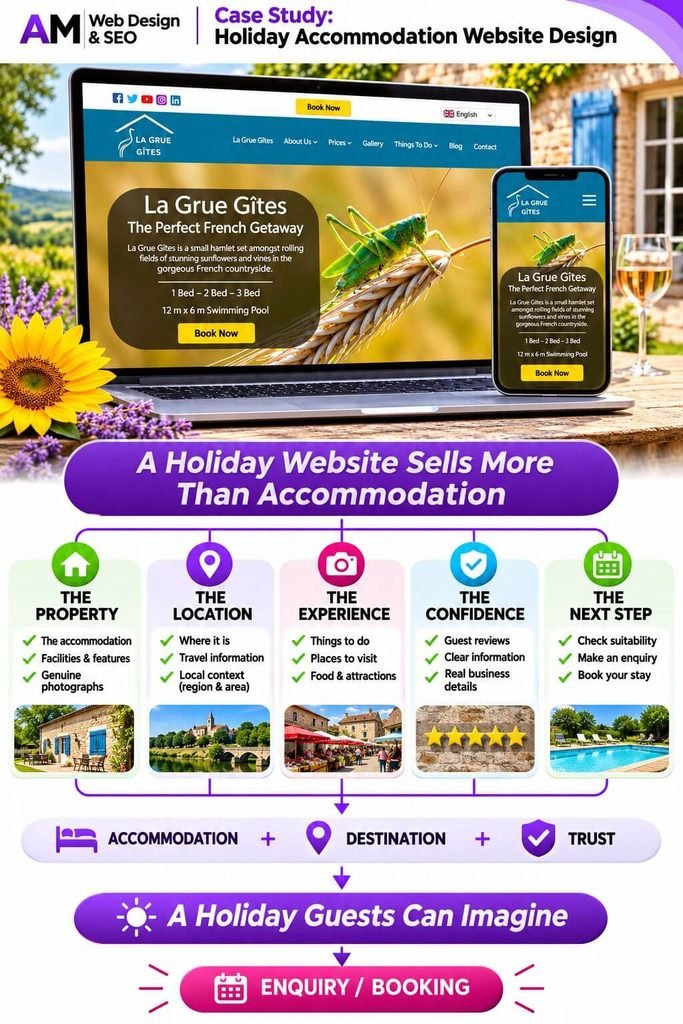
A useful accommodation website therefore needs to answer five broad questions:
WHAT WILL I BE STAYING IN?
Show and explain the accommodation.
WHERE IS IT?
Give the visitor geographical context.
WHAT CAN I DO THERE?
Sell the destination as well as the property.
CAN I TRUST THIS BUSINESS?
Use genuine photographs, useful information, reviews and clear business details.
HOW DO I BOOK OR ENQUIRE?
Give the visitor an obvious next step.
When those pieces work together, the website becomes much more than an online brochure.
Does Your Holiday Accommodation Need A Better Website?
Independent accommodation businesses don’t all need the same website.
A small property with relatively straightforward information may be suitable for my Essential Website Design package.
Accommodation businesses needing more pages for facilities, the local area, activities and useful guest content may be better suited to Business Website Design.
If you already have an accommodation website and aren’t sure what actually needs improving, my Website MOT provides a personal website review, written report, prioritised action plan and 20-minute walkthrough for £197.
The aim is to create a website that helps potential guests understand why they might want to stay with you.
Frequently Asked Questions About Holiday Accommodation Website Design
What should a holiday accommodation website include?
A holiday accommodation website should provide clear information about the property, genuine photographs, facilities, location, the surrounding area, contact or booking information and answers to important guest questions.
The exact structure should reflect the accommodation and the people it is trying to attract.
Are professional photographs important for accommodation websites?
Strong genuine photographs are particularly valuable because potential guests need to see where they may be staying.
Photography can communicate the character, space, facilities and atmosphere of a property in ways text alone cannot.
Should a holiday accommodation website include local area information?
Yes. The destination is part of the holiday.
Useful information about attractions, activities, towns, restaurants and places to visit can help potential guests decide whether the overall experience is right for them.
Can blogging help a holiday accommodation website?
It can when the articles are genuinely useful.
Local guides, things to do, places to visit and answers to common guest questions can support potential visitors while creating additional useful content for search engines.
Should an accommodation business rely entirely on booking platforms?
Third-party booking platforms can provide valuable routes to customers, but an independent website gives the accommodation provider greater control over its brand, content, destination information and direct relationship with potential guests.
The two approaches don’t have to be mutually exclusive.