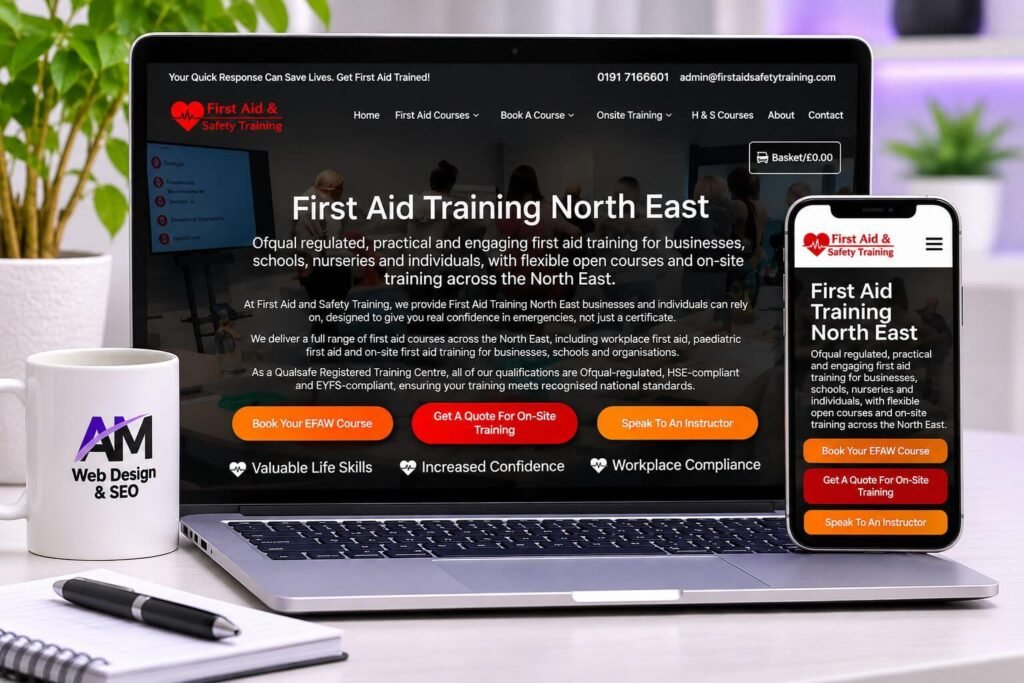
First Aid & Safety Training Ltd is an established first aid training provider delivering regulated workplace and paediatric first aid qualifications to individuals and organisations across the North East. This first aid training website design project shows how a growing training business can structure its website around different courses, locations, customer needs and search visibility.
As the business developed, its website needed to do much more than simply explain who the company was and provide a contact form.
Different customers were looking for different courses. Training was being delivered from multiple locations. Employers needed information about onsite training, while individuals needed to find suitable open courses. The website also needed to support useful first aid content, explain qualification and compliance requirements and provide clear routes for people ready to book or enquire.
First Aid & Safety Training Ltd is also a business I run alongside my wife Helen. This has given me the opportunity to continually develop the website as the training business itself has grown and to see first-hand how its structure needs to change when new courses, locations and customer requirements are introduced.
The project is a good example of why larger business websites need to be planned around the information customers are actually looking for, rather than simply adding more pages as a business grows.
Project Overview
Client: First Aid & Safety Training Ltd
Sector: First Aid Training
Location: North East England
Project: Advanced Website Design, Content & Search Visibility
Services: Website Design, Website Content, Local SEO, Search Optimisation and Lead Generation
Website: Visit the First Aid & Safety Training website
The First Aid Training Website Design Challenge
First Aid & Safety Training provides several different types of first aid training.
Someone responsible for workplace training may be searching for an Emergency First Aid at Work course, while another organisation may require the full First Aid at Work qualification.
A nursery or childcare provider has different requirements again and may be looking specifically for Paediatric First Aid training.
There are also two very different ways customers can access training.
Individuals and smaller organisations can book places on scheduled open courses, while businesses with several people to train may prefer a course delivered specifically for their organisation.
Trying to explain all of that through a homepage and one general training page would make it difficult for both customers and search engines to understand the website.
The first aid training website design therefore needed to do more than simply create a professional-looking training website. It needed a structure that could grow with the business while making its different courses, locations and training options easy to understand.
This is the type of project my Advanced Website package is intended for: businesses that genuinely need additional space and structure rather than a larger website simply for the sake of having more pages.
What Did The Training Business Need From Its Website?
Before thinking about individual pages, it was important to understand what different visitors might actually be trying to accomplish.
The website needed to:
- Clearly explain the different first aid qualifications available
- Help individuals find and book suitable open courses
- Give employers information about onsite workplace training
- Explain where scheduled courses are delivered
- Provide useful information about first aid and training requirements
- Demonstrate the company’s qualifications and credibility
- Work effectively on mobile devices
- Provide clear routes to make an enquiry or book training
- Support visibility for relevant course and location searches
- Allow the website to continue growing as new courses and locations were introduced
This is an important distinction when planning a larger business website.
The number of pages should follow what customers need from the website, rather than deciding on an arbitrary number of pages first.
Building The Website Around Individual First Aid Courses
One of the most important first aid training website design decisions was giving the main training courses their own dedicated areas of the website.
Rather than placing every qualification onto a single First Aid Courses page, important courses can be properly explained individually.
This allows someone interested in Emergency First Aid at Work to find information specifically about that qualification without having to work through information about unrelated courses.
The same principle applies to First Aid at Work and Paediatric First Aid.
Dedicated course content also provides more room to answer the questions someone is likely to have before booking.
That might include who the qualification is for, how long the training takes, what is covered and whether it meets the requirements relevant to their workplace or sector.
For search engines, it also creates a clearer relationship between an individual webpage and the subject it is intended to cover.
Separating Open Courses From Onsite Training
Another important part of the structure was recognising that someone searching for an individual course place has a different requirement from an employer arranging training for a team.
Open courses need to help people understand:
- Which qualification they need
- Where the training is taking place
- When courses are available
- How they can book a place
Onsite training has a different customer journey.
An employer is more likely to want information about:
- Which course is appropriate
- How many people can attend
- Whether training can be delivered at their workplace
- What the organisation needs to provide
- How to request a quotation
Separating these journeys makes the website easier to use and allows the content to answer the right questions at the right stage.
It also avoids trying to make one page serve several very different search intentions.
First Aid Training Website Design For Multiple Locations
As First Aid & Safety Training expanded its open-course programme, location became another important part of the website.
Someone looking for first aid training will often include a location when searching.
They may not simply search for Emergency First Aid at Work. They may look for an Emergency First Aid course in the particular area where they live or work.
Location information therefore needs to be genuinely useful.
Rather than creating pages that simply change the name of a town, useful location content can explain what training is available, where it takes place and how someone can book.
For a first aid training website design covering several training venues, this creates a much stronger structure than trying to list every location on one generic page.
It also gives visitors a clearer route from searching for training in their area to finding an appropriate course.
This same principle forms part of the approach I use for Local SEO services. Location content should help a genuine customer understand where and how a business operates, rather than existing purely to insert different town names into otherwise identical pages.
Building Useful Content Into The First Aid Training Website Design
A training website also has opportunities to answer questions before somebody is ready to book.
First aid requirements can sometimes be confusing.
Employers may be trying to understand which qualification they require. Childcare providers may be looking for information relating to paediatric first aid requirements. Someone whose certificate is approaching expiry may be unsure whether they need a full course or requalification training.
Useful website content can answer those questions while supporting the main commercial pages.
This is one of the reasons I don’t see a business blog as something that should simply be filled with articles because somebody has decided a website needs a new post every week.
Content should have a purpose.
For First Aid & Safety Training, that means creating information around genuine first aid, workplace and training questions that potential customers may be researching.
Where appropriate, those articles can then lead naturally to the relevant course or service page.
This is also how I approach website content writing. The aim is to create useful content that supports the main website rather than adding words simply to make the site bigger.
Supporting Search Visibility Through First Aid Training Website Design
Search engine optimisation isn’t something that should simply be added after a website has been built.
The structure of the website itself plays an important role.
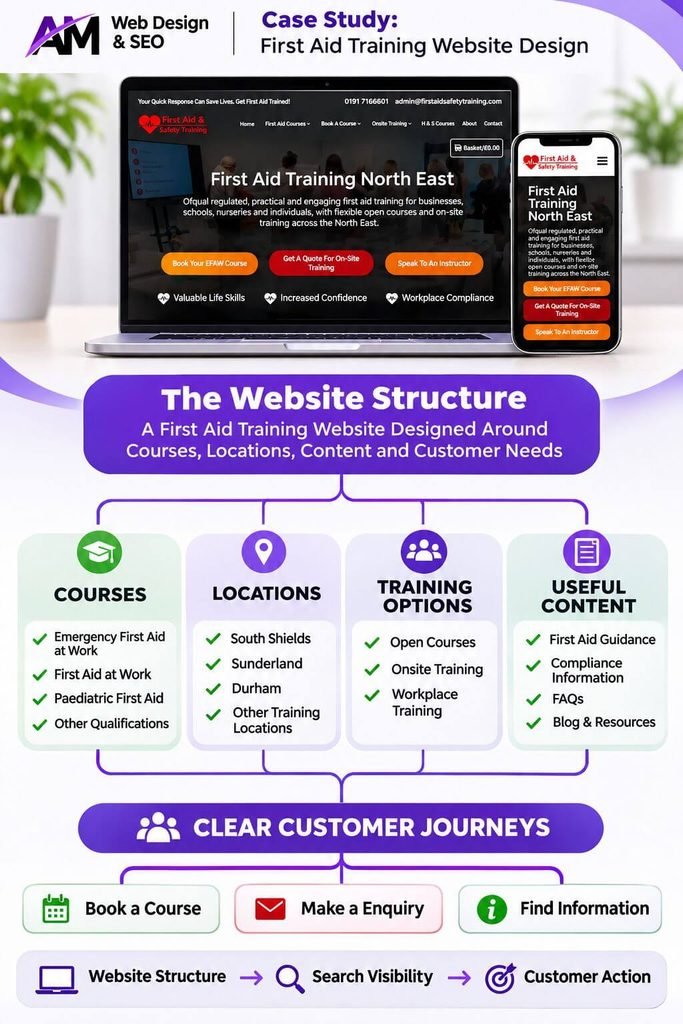
For First Aid & Safety Training, this means creating clear relationships between:
Courses
What training does the business provide?
Locations
Where can someone attend training?
Onsite Training
Can the business deliver training for an organisation?
Information & Guidance
What questions are potential customers asking before they choose a course?
These areas can then be connected through relevant internal links.
A useful article about workplace first aid requirements, for example, can lead someone towards Emergency First Aid at Work or First Aid at Work training.
A course page can direct somebody towards available training locations.
A location page can help someone find the appropriate course.
The aim isn’t to create as many pages as possible.
It is to create a website where the pages have clear purposes and work together.
This combination of website structure, content and local relevance is also why I treat getting a business found online as something broader than simply adding keywords to individual pages.
Making Compliance Information Easier To Find
Trust is particularly important when somebody is choosing a training provider.
Businesses and organisations need to know that the training they are purchasing is appropriate for their requirements.
The website therefore also provides space for information relating to qualifications, regulatory requirements and relevant first aid guidance.
This type of content serves two purposes.
It helps existing and potential customers understand their responsibilities, while also demonstrating that the training provider understands the environment in which its customers operate.
For businesses in regulated or compliance-led sectors, this type of supporting content can be just as important as the main service pages.
Creating Clear Routes To Enquire And Book
Getting somebody onto a website is only part of the job.
The next question is what happens when they get there.
Different visitors to the First Aid & Safety Training website may be ready to take different actions.
Someone looking at a scheduled course may be ready to book.
An employer researching onsite training may need to make an enquiry.
Someone reading an informational article may still be working out which qualification they require.
The website therefore needs clear routes between information and the appropriate next step without turning every page into an aggressive sales page.
This is something I consider when building website enquiry forms and calls to action.
A good enquiry system should collect the information a business actually needs while making it straightforward for the customer to take the logical next step.
Designing The First Aid Training Website For Mobile Visitors
A first aid training website design can’t be planned only around how it looks on a desktop computer.
Potential customers may discover a training provider through Google Search, Google Maps, social media, an email or a recommendation and then visit the website from their phone.
Course information, navigation, contact details and enquiry routes therefore need to remain straightforward on smaller screens.
This becomes particularly important on larger websites.
A navigation structure that seems manageable on a desktop can quickly become difficult to use on a phone if it hasn’t been properly planned.
Mobile usability was therefore considered as part of the overall website structure rather than as something to address after the desktop website was finished.
A First Aid Training Website Design That Can Continue To Develop
One of the biggest advantages of planning the structure properly is that the website doesn’t have to remain static.
First Aid & Safety Training has continued to develop its courses, locations and content.
The website can develop alongside it.
New training locations can be incorporated into the existing structure.
New qualifications can be added without having to rethink the entire website.
New articles can support existing course content.
New compliance information can be added when requirements change.
This is particularly important for growing businesses.
A website that works when a company has three services may become difficult to manage when it has ten services, several locations and hundreds of pieces of content.
Thinking about that growth early makes future development considerably easier.
The Finished First Aid Training Website Design
The finished first aid training website design has developed into much more than a simple online brochure.
It provides a central online platform for First Aid & Safety Training’s courses, training locations, onsite training, compliance information and first aid content.
Importantly, those elements aren’t treated as completely separate parts of the website.
They support one another.
Course information connects with locations.
Useful content connects with relevant training.
Compliance information supports trust.
Enquiry and booking routes give visitors a clear next step.
The result is a website structure capable of supporting the business as its training programme continues to develop.
You can visit the First Aid & Safety Training website to see how the different courses, locations, guidance and enquiry routes work together.
What Can Other Small Businesses Learn From This Project?
The biggest lesson from this project isn’t that every business needs a large website.
Most don’t.
It’s that the structure of a website should reflect the structure of the business and the information customers actually need.
If your business provides one straightforward service, a five-page website may be perfectly adequate.
If you provide several services, operate in different locations, answer complex customer questions or need to support different types of customer, trying to squeeze everything into five pages can make the website harder to use and harder to develop.
Before deciding how big a website should be, I think it’s more useful to ask:
What services are customers looking for?
What questions do they have?
Do different customers need different information?
Does location affect what they’re searching for?
What should somebody do after finding the information they need?
Those answers should determine the website structure.
Does Your Business Need A Larger Website?
My Advanced Website package is designed for businesses that need more room for their services, locations, sectors, content or customer journeys.
It includes up to 30 substantive pages and provides the additional structure needed for a more complex business website.
If your existing website has grown without a clear structure, you may not necessarily need to start again either. A website redesign can retain what is useful while improving the areas that no longer work.
The important thing is choosing the right website for the business rather than simply choosing the biggest package.
Frequently Asked Questions About First Aid Training Website Design
How many pages should a business website have?
There isn’t a single number that is right for every business.
The website should have enough pages to properly explain the important services, information and customer journeys without creating unnecessary content. A straightforward business may only need a handful of pages, while a company with several services, locations or customer types may benefit from a larger structure.
Should every service have its own webpage?
Not necessarily.
A minor service may fit naturally within a broader service page. However, important services that customers actively research often benefit from dedicated pages where there is enough useful information to justify them.
Do businesses operating in several locations need location pages?
Location pages can be useful where a business genuinely serves or operates from different areas and there is useful location-specific information to provide.
They shouldn’t simply be duplicate pages where only the town name has been changed.
Can website structure help SEO?
Yes. A logical website structure can make it easier for both visitors and search engines to understand the relationship between services, locations and supporting content.
Website structure is only one part of search optimisation, but it provides an important foundation.
Does every business need an advanced website?
No.
A smaller website is often the better option for a straightforward business.
An advanced website becomes useful when there are enough genuine services, locations, sectors, resources or customer journeys to justify the additional structure.