
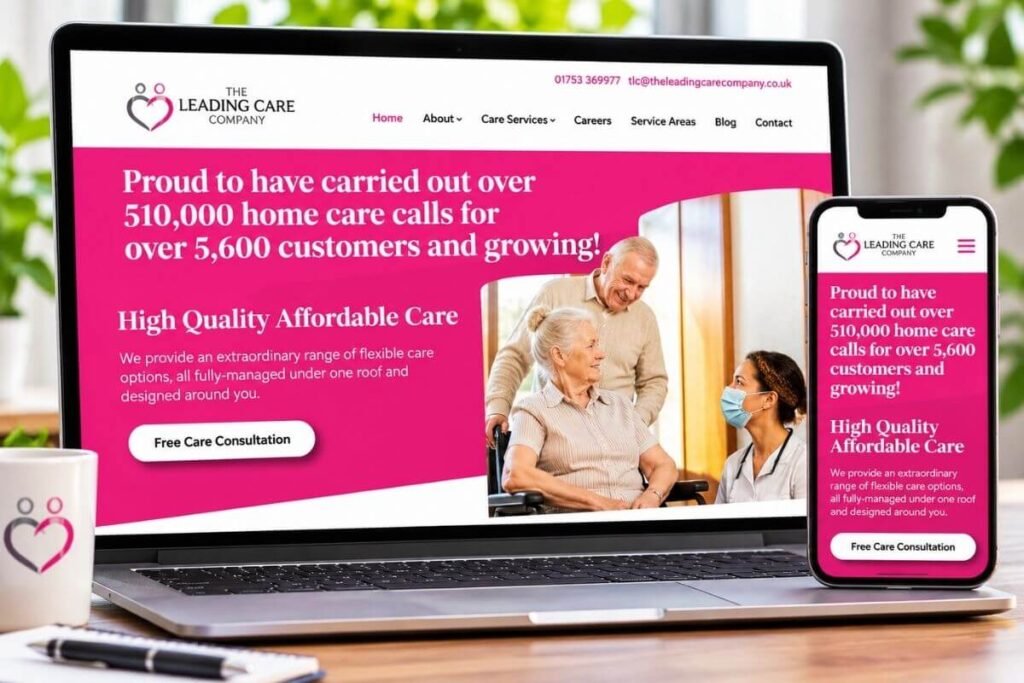
The Leading Care Company provides care and support services to people and families looking for professional help. This care company website design case study shows why a care website needs to do more than list services. It needs to explain those services clearly, build confidence in the organisation and make it easy for someone to take the next step.
Choosing care can be a significant decision.
The person visiting the website may be looking for support for themselves, a parent or another family member. They may be researching care for the first time and trying to understand what help is available.
That makes the customer journey very different from many other industries.
Visitors aren’t necessarily looking for the cheapest service or the quickest online transaction.
They are often looking for reassurance.
The website therefore needs to answer practical questions while helping the visitor understand the people and organisation behind the care.
Project Overview
Client: The Leading Care Company
Sector: Care & Support Services
Project: Care Company Website Design & Online Visibility
Services: Website Design, Website Content, Service Structure and Search Optimisation
Website: Visit Leading Care
The Care Company Website Design Challenge
The main care company website design challenge is trust.
Care is personal.
A potential customer isn’t simply choosing a product. They may be deciding who they are comfortable allowing into their home or who they trust to provide support to somebody important to them.
The website needs to recognise that.
It still needs to explain services and provide practical information, but it shouldn’t feel like a catalogue.
Visitors need to understand:
Who is Leading Care?
What support is available?
Who are the services for?
Where is support provided?
What makes the organisation credible?
How can I speak to somebody?
The design, structure and content all need to help answer those questions.
What Does A Care Company Need From Its Website?
Before considering SEO, the website needs to work for the people using it.
For a care provider, that means making important information straightforward to find and understand.
The website needs to:
- Clearly explain the care and support available
- Help visitors identify the service relevant to them
- Explain who the organisation supports
- Introduce the business behind the services
- Build trust and confidence
- Make contact information easy to find
- Work properly on mobile devices
- Use clear, readable content
- Provide room for important service information
- Support search visibility around relevant services
This is why I don’t begin a website project by deciding how many pages I can sell.
The structure needs to reflect what the organisation actually needs to communicate.
For businesses and organisations with several important services, my Business Website Design package provides room to build that structure properly.
Building The Care Company Website Design Around People
A care company website design should ultimately be built around people rather than services.
That might sound like a small distinction, but it changes how the website is approached.
The organisation naturally thinks in terms of the services it provides.
A visitor may think differently.
They may be asking:
Can somebody help my mam or dad remain independent?
What support is available at home?
Can you help with this particular situation?
How does care actually work?
Who will I be dealing with?
Good website structure connects those customer questions with the appropriate services.
The visitor shouldn’t need to understand care-sector terminology before they can find useful information.
Explaining Care Services In Plain English
Care services can involve terminology that professionals understand but families may encounter for the first time.
That makes clear website content writing particularly important.
The website needs to explain what a service actually means for the person receiving it.
Rather than relying on labels alone, useful content can explain:
- What the service involves
- Who it may help
- What type of support may be available
- How the service works
- What someone should do if they want more information
This helps the customer, but it also gives search engines better information about what each page is actually about.
Useful SEO content and useful customer content don’t need to be two different things.
The strongest pages often achieve both.
Care Company Website Design And Trust
Trust needs to run throughout the care company website design.
It shouldn’t be confined to a paragraph on the About page.
Visitors can form an impression from every part of the website.
That includes:
- How clearly the organisation identifies itself
- Whether contact information is easy to find
- How services are explained
- Genuine information about the company
- Reviews or testimonials where appropriate
- Relevant accreditations or registrations
- Genuine photography where available
- Consistent branding
- Professional presentation
- Clear routes to ask questions
No website can make the decision for the customer.
But it can make it considerably easier for someone to decide whether they want to have a conversation with the organisation.
For a care provider, that conversation may be the most important conversion the website creates.
Making The Website Easy To Understand
Accessibility isn’t only about technical compliance.
It is also about communication.
A care website may be used by people with very different levels of digital confidence.
Some visitors may regularly research services online.
Others may be using a website because they suddenly need to arrange support and don’t know where else to begin.
The design therefore benefits from being straightforward.
Clear headings.
Readable text.
Obvious navigation.
Sensible contrast.
Logical page layouts.
Easy-to-find contact details.
Simple enquiry routes.
These aren’t particularly exciting design features.
They are much more important than that.
They make the website easier to use.
Structuring Important Care Services Properly
Where a care provider offers several significant services, trying to explain everything on one page can make the website difficult to use.
Dedicated service pages can provide enough space to properly explain important areas of support.
This gives each service somewhere to answer its own questions.
It can also help visitors move from general information towards something more specific.
For example:
Homepage
↓
Care Services
↓
Specific Service
↓
Understand The Support
↓
Contact Leading Care
The website becomes a guided journey rather than a collection of unrelated pages.
Helping People Find The Right Information
Navigation becomes particularly important when visitors arrive with different needs.
Someone may enter through the homepage.
Another person may arrive directly on a service page from Google.
Someone else may have been given the company’s name and simply wants to check who they are.
Every important page therefore needs to make sense as a potential starting point.
This is one reason internal linking matters.
A visitor reading about one service may need information about another.
Someone learning about the organisation may want to move towards its services.
A service page should make the next step clear.
The same links also help search engines understand relationships between the website’s pages.
Good internal linking is therefore useful to both people and search engines.
Search Visibility For A Care Company Website
A care company website design can also provide the foundation for stronger search visibility.
People don’t necessarily search for a company by name.
They may search around the support they need.
That means individual service pages can be important.
Instead of expecting the homepage to be relevant to every possible search, the website can provide useful information around specific areas of care.
Search optimisation can then build around:
- Genuine services
- Useful service information
- Clear headings
- Page titles and descriptions
- Internal links
- Location relevance where appropriate
- Customer questions
- Helpful content
- Consistent business information
This is a much stronger foundation than simply repeating keywords throughout the homepage.
My wider Get Found Online approach is built around connecting these different elements rather than treating SEO as a separate layer added after the website is finished.
Using Helpful Content To Answer Care Questions
Care naturally creates questions.
Families may want to understand different types of support before they are ready to contact a provider.
That creates opportunities for useful website content.
Articles and guides can explain subjects in more detail than a commercial service page.
They can answer genuine questions.
They can help someone understand terminology.
They can explain what to consider.
They can direct somebody towards a relevant service when appropriate.
This is where blog writing can become useful.
The purpose isn’t to publish large numbers of generic articles.
It is to identify questions that potential customers genuinely ask and create worthwhile answers.
Making Contact Feel Straightforward
For a care website, the desired next step isn’t always an immediate purchase.
Often it is simply:
Speak to us.
That needs to feel straightforward.
Telephone numbers should be easy to find.
Contact pages shouldn’t create unnecessary barriers.
Enquiry forms shouldn’t ask for information the organisation doesn’t need.
Calls to action should be clear without becoming aggressive.
This is especially important when somebody may already be dealing with a difficult or unfamiliar situation.
A well-planned website enquiry form can collect enough information to help start the conversation without making the visitor complete a lengthy application process.
Designing The Care Company Website For Mobile
A care company website design needs to work properly on a mobile phone.
Someone researching care may not be sitting at a desktop computer.
They may be searching from home, work or while visiting the person they are trying to support.
Important information therefore needs to remain easy to access on a smaller screen.
That means:
- Readable text
- Clear headings
- Simple navigation
- Properly sized buttons
- Easy telephone links
- Forms that work on mobile
- Images that don’t overwhelm the content
- Clear next steps
Mobile design shouldn’t be an afterthought.
It is part of how the website is planned from the beginning.
The Website As Part Of A Wider Online Presence
The website provides the main place where Leading Care can properly explain its organisation and services.
But it isn’t necessarily the first place somebody encounters the company.
A potential customer may see the business in search results, find information elsewhere online or receive a recommendation and then search for the company.
That makes consistency important.
The name, contact information, services and overall picture of the organisation should make sense wherever somebody encounters it.
For businesses serving defined geographical areas, Local SEO can help connect services, location and business information more clearly.
The website remains the foundation that the wider online presence can point back towards.
The Finished Care Company Website Design
The finished care company website design gives Leading Care a professional platform for explaining its services and organisation.
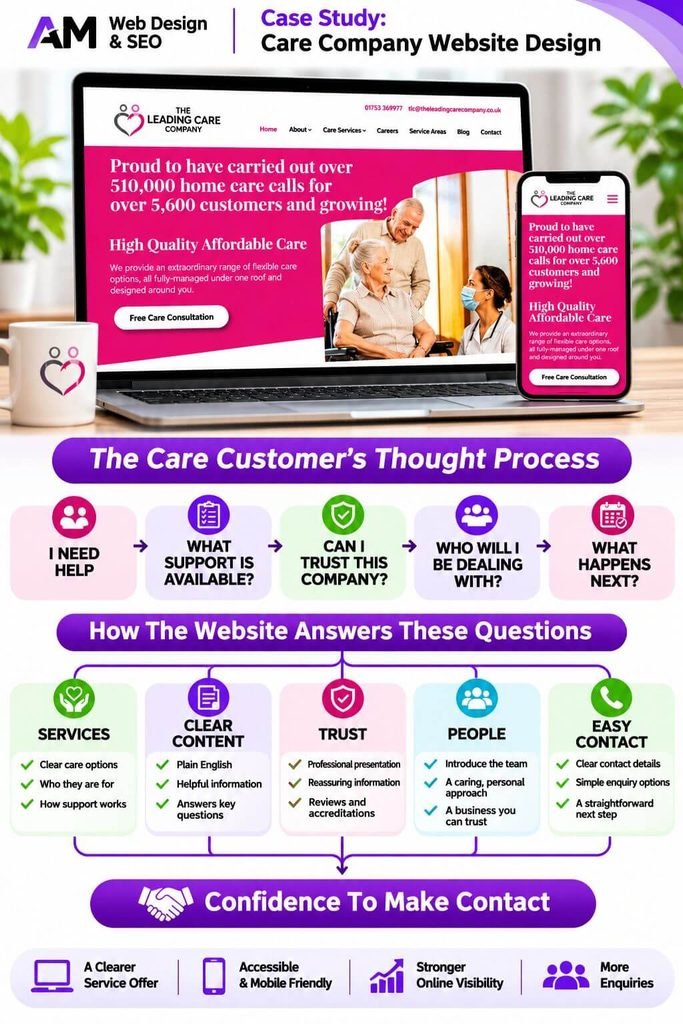
The website can help somebody move from:
I need some help
to
I understand the type of support available
to
I know more about the organisation
to
I’m ready to have a conversation.
That is the customer journey the website needs to support.
It doesn’t need gimmicks.
It needs clarity, trust and useful information.
You can visit the Leading Care website to see the live project.
What Can Other Care Providers Learn From This Project?
The biggest lesson from Leading Care is that a care website isn’t really about the website.
It’s about the person using it.
They may be worried.
They may be confused about the options.
They may be researching on behalf of somebody else.
They may not understand industry terminology.
They may simply want to speak to a real person.
That means a good care website should answer some very human questions:
Can you help us?
What support do you provide?
Can we trust you?
Who are you?
What happens next?
Design, content and SEO should support those questions rather than get in their way.
For me, that is what makes a successful care company website design.
Does Your Care Business Need A Better Website?
If your care business has several important services that need to be explained properly, my Business Website Design package provides room for a clearer service structure.
If your existing website has grown outdated or no longer represents the organisation properly, Website Redesign & Rebuild may be more appropriate.
And if you aren’t sure what actually needs changing, my Website MOT provides a personal review, written report and prioritised action plan before you commit to a larger project.
The starting point should always be what the organisation and its customers genuinely need.
Frequently Asked Questions About Care Company Website Design
What should a care company website include?
A care company website should clearly explain the services available, who those services are for, information about the organisation, relevant trust information and straightforward ways to make contact.
The exact structure should reflect the services the provider genuinely offers.
Why is trust so important on a care website?
People may be choosing support for themselves or somebody important to them.
Clear information about the organisation, its services, people, standards and contact details can help potential customers make a more informed decision about whether they want to start a conversation.
Should every care service have its own website page?
Important services can benefit from dedicated pages where there is enough useful information to explain them properly.
Closely related services can sometimes be grouped together.
The objective is to make the website easier to understand, not simply to increase the number of pages.
Is SEO useful for a care company?
Yes. Potential customers may search around the type of care or support they need rather than searching for a particular company.
Clear service pages, useful content, sensible website structure and local relevance can all contribute to search visibility.
Should care websites have a blog?
Only if the content is useful.
A care provider is likely to encounter many genuine questions from customers and families. Those questions can provide valuable topics for articles and guides that help people understand their options.