
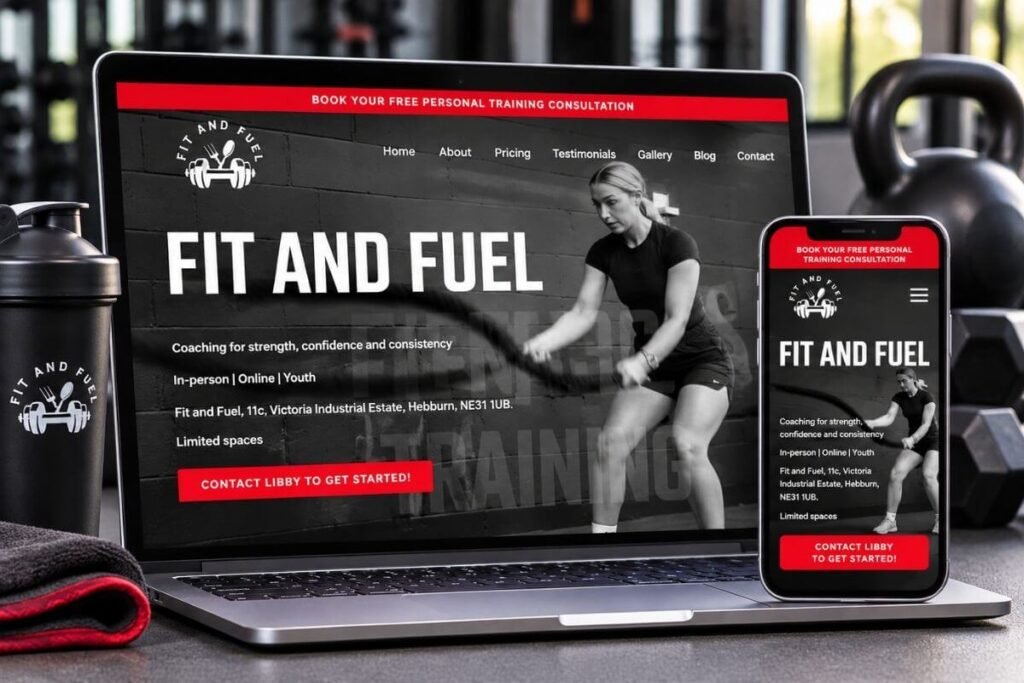
Fit & Fuel Ltd is a personal training and fitness business built around individual coaching, fitness and helping clients achieve their goals. This personal trainer website design case study shows how a website can take a business that is closely connected to one person and turn that personality, experience and range of services into a professional online presence.
Personal training is different from many other services.
Potential clients aren’t simply choosing a gym or buying access to equipment. They are choosing somebody they may work closely with every week.
Qualifications and services matter, but so do personality, approach, experience and trust.
The Fit & Fuel website therefore needs to do more than say “personal training available”.
It needs to help potential clients understand what Fit & Fuel offers, who is behind the business, the different ways somebody can train and what they should do next.
Project Overview
Client: Fit & Fuel Ltd
Sector: Personal Training & Fitness
Location: Hebburn, South Tyneside
Project: Personal Trainer Website Design
Services: Website Design, Website Content, Service Structure and Local Search Foundations
Website: Visit Fit & Fuel
The Personal Trainer Website Design Challenge
The main personal trainer website design challenge is that the trainer is a major part of the product.
Someone considering personal training isn’t only asking:
What does this cost?
They may also be asking:
Who will I be training with?
Will I feel comfortable with them?
Do they understand what I want to achieve?
What experience do they have?
What type of training do they provide?
Is this suitable for somebody like me?
That means hiding the trainer behind generic fitness photographs and marketing language can actually weaken the website.
The person behind the business needs to be visible.
Building The Website Around The Personal Trainer
For Fit & Fuel, the business has a strong personal story.
Libby isn’t simply somebody who decided to start offering gym sessions.
Her background includes personal training, nutrition, sports development, boxing and coaching.
That combination helps explain the business and its approach to fitness.
The website therefore needs to introduce the person behind Fit & Fuel rather than presenting it as a faceless fitness company.
This is an important principle for many owner-operated businesses.
Being small isn’t something the website needs to disguise.
Direct access to an experienced business owner can actually be one of the reasons a customer chooses the company.
That’s something I also emphasise throughout my own web design services. Clients deal directly with me rather than being passed between salespeople, account managers and designers.
What Does A Personal Trainer Website Need?
Before thinking about search engines, a personal trainer’s website needs to work for potential clients.
For Fit & Fuel, that means helping somebody understand:
- Who the trainer is
- What qualifications and experience they have
- What training options are available
- Who the different services are suitable for
- Where training takes place
- What makes Fit & Fuel different
- How somebody can get started
- How to make contact
The website also needs to work properly on mobile devices because many potential clients will first encounter the business through their phone.
These requirements determine the structure.
The number of pages comes afterwards.
Personal Trainer Website Design With A Strong Personal Brand
A successful personal trainer website design shouldn’t look as though the trainer could be replaced with anybody else and nobody would notice.
Fit & Fuel has its own identity.
The website needs to carry that identity through its photographs, content, typography, messaging and overall presentation.
That doesn’t mean filling every section with branding.
It means creating consistency.
When somebody moves from the website to another part of the Fit & Fuel presence, it should still feel like the same business.
This is particularly important for businesses where the owner’s personality is central to the service.
Explaining Different Ways To Train
One challenge for a growing fitness business is explaining the different ways somebody can work with the trainer.
Not every potential client wants the same thing.
Some may want regular one-to-one personal training.
Others may prefer training with another person.
Some may be interested in classes.
Others may want online coaching or a combination of in-person and remote support.
As Fit & Fuel develops, youth strength and conditioning and other training options can also create different customer journeys.
Trying to explain everything in one large block of text quickly becomes confusing.
The website structure needs to separate the options enough that somebody can identify the route that suits them.
This is where a larger Business Website Design can become useful as a fitness business grows.
Writing Fitness Content For Real People
Fitness is an industry full of terminology.
Strength.
Conditioning.
Hyrox.
Hybrid training.
Nutrition.
Programming.
Progressive overload.
Someone already interested in fitness may understand all of those terms.
A potential client who simply wants to become fitter, stronger or more confident may not.
Good website content writing needs to connect the professional service with the customer’s actual goal.
Instead of only explaining the training method, the website can help somebody understand what that training could mean for them.
This makes the content easier for customers to understand while still giving search engines useful context about the services provided.
Showing Qualifications Without Making The Website About Certificates
Qualifications matter in personal training.
They demonstrate professional development and help customers understand the trainer’s background.
But most potential clients don’t visit a personal trainer website because they want to read a list of certificates.
Qualifications work best when they support the wider story.
For Fit & Fuel, Libby’s background in personal training, nutrition, boxing coaching and sports development helps demonstrate the knowledge behind the service.
The website can establish that professional credibility while keeping the focus on what the customer actually wants to achieve.
Using Genuine Fitness Photography
A personal trainer website design benefits enormously from genuine photography.
Fitness websites are easy to fill with generic photographs of perfect-looking people lifting weights.
The problem is that those photographs tell a potential client almost nothing about the actual business.
Genuine imagery can show:
- The trainer
- The training environment
- Real coaching
- Equipment
- Classes
- The atmosphere
- Different types of training
That makes the website feel connected to the real Fit & Fuel experience.
For a personal service business, that authenticity can be considerably more valuable than polished stock photography.
Building Trust Through Real Results And Experience
Potential personal training clients often want reassurance that the trainer knows what they are doing and understands people like them.
That makes genuine evidence valuable.
Depending on what is available and appropriate, this can include:
- Client feedback
- Testimonials
- Training photographs
- Qualifications
- Coaching experience
- Awards
- The trainer’s own background
- Clear explanations of the approach
Fit & Fuel has also received external recognition, including being named Best Personal Trainer in South Tyneside in the 2026 Quality Business Awards.
Information like this can support credibility without needing to dominate the website.
Trust is usually strongest when several genuine signals reinforce one another.
Personal Trainer Website Design For Local Search
A personal trainer website design also needs to establish where the service is available.
For an in-person fitness business, location matters.
Someone searching for personal training generally needs a trainer they can realistically travel to.
Fit & Fuel is based in Hebburn, which makes the relationship between the business, its services and South Tyneside important.
The website should make that geographical relevance clear naturally.
This is part of the foundation behind my Local SEO services.
Local SEO doesn’t begin by creating a page for every town within driving distance.
It begins by making the real business, services and location easy to understand.
Connecting The Website With Google Business Profile
Google Business Profile can also support a local fitness business.
Someone may discover Fit & Fuel through Google Search or Maps before visiting the website.
They may want to see:
- Reviews
- Photographs
- Business information
- Location
- Opening information
- Contact details
- Recent activity
- The website
The profile and website should therefore support the same overall picture of the business.
My Google Business Profile services are designed around making that wider local presence clearer and more useful.
For a local personal trainer, genuine reviews and imagery can be particularly valuable because they give potential clients additional information before making contact.
Creating Clear Journeys For Different Fitness Clients
Not every Fit & Fuel visitor arrives with the same objective.
One person may want one-to-one training.
Another may be interested in a class.
A parent may be researching youth strength and conditioning.
Someone else may be considering online coaching.
That means the website needs multiple clear routes without becoming complicated.
A useful structure might work like this:
Potential Client
↓
What Are You Looking For?
↓
Personal Training | Classes | Youth Training | Online Coaching
↓
Understand The Option
↓
Make An Enquiry
The website is helping the visitor self-select the information relevant to them.
That can also improve the quality of enquiries because somebody has already learned more about the service before making contact.
Making The Next Step Simple
Once a potential client is interested, the website shouldn’t make getting started unnecessarily difficult.
The exact next step depends on how the business operates.
It could be:
Make an enquiry
Arrange a consultation
Ask about availability
Find out which option is suitable
The important part is clarity.
Calls to action need to reflect what actually happens next rather than using generic buttons such as “Learn More” everywhere.
Where the business needs additional information before responding, a structured website enquiry form can collect useful details without overwhelming the potential client.
Designing The Fitness Website For Mobile
A personal trainer website design has to work particularly well on mobile.
Fitness businesses often have strong social and mobile audiences.
Someone might hear about the trainer from a friend, see the business elsewhere online or search for personal training while using their phone.
The mobile website therefore needs:
- Clear navigation
- Strong imagery that still works on a smaller screen
- Readable content
- Easy contact options
- Properly sized buttons
- Clear service choices
- Simple enquiry routes
- Fast access to important information
Mobile visitors shouldn’t receive a compromised version of the business.
They need the same clear journey in a format designed for a smaller screen.
Creating Content Around Fitness Questions
A fitness business also has considerable potential for useful ongoing content.
Potential clients have questions about:
- Personal training
- Strength training
- Nutrition
- Getting started
- Training frequency
- Youth fitness
- Boxing fitness
- Exercise confidence
- Different types of classes
Those questions can provide useful topics for future website articles.
This is where blog writing can support the main website.
The purpose isn’t to turn the personal trainer into a full-time content creator.
It is to identify worthwhile questions and create content that supports the services already offered.
One useful article every so often can be considerably more valuable than publishing generic fitness posts simply to maintain a schedule.
A Website That Can Grow With The Fitness Business
One of the most important considerations with Fit & Fuel is growth.
A fitness business can change considerably.
New classes can be introduced.
Training locations can change.
New qualifications can expand the services available.
Youth programmes can develop.
Online coaching can grow.
A website shouldn’t need rebuilding every time the business evolves.
The underlying structure should provide enough flexibility for new services and content to be added sensibly.
That is why planning matters even when the first version of a website is relatively straightforward.
The website needs to work for the business now without making future development unnecessarily difficult.
The Finished Personal Trainer Website Design
The finished personal trainer website design gives Fit & Fuel a professional online base that still feels connected to the person behind the business.
It helps a potential client move through a straightforward journey:
Discover Fit & Fuel
↓
Meet The Trainer
↓
Understand The Training Options
↓
See Experience And Credibility
↓
Choose The Relevant Service
↓
Make Contact
The website isn’t trying to replace the relationship between trainer and client.
Its job is to help start that relationship.
You can visit the Fit & Fuel website to see the live project.
What Can Other Personal Trainers Learn From This Project?
The biggest lesson from Fit & Fuel is that the trainer shouldn’t disappear behind the website.
For an owner-operated fitness business, you are part of what the customer is choosing.
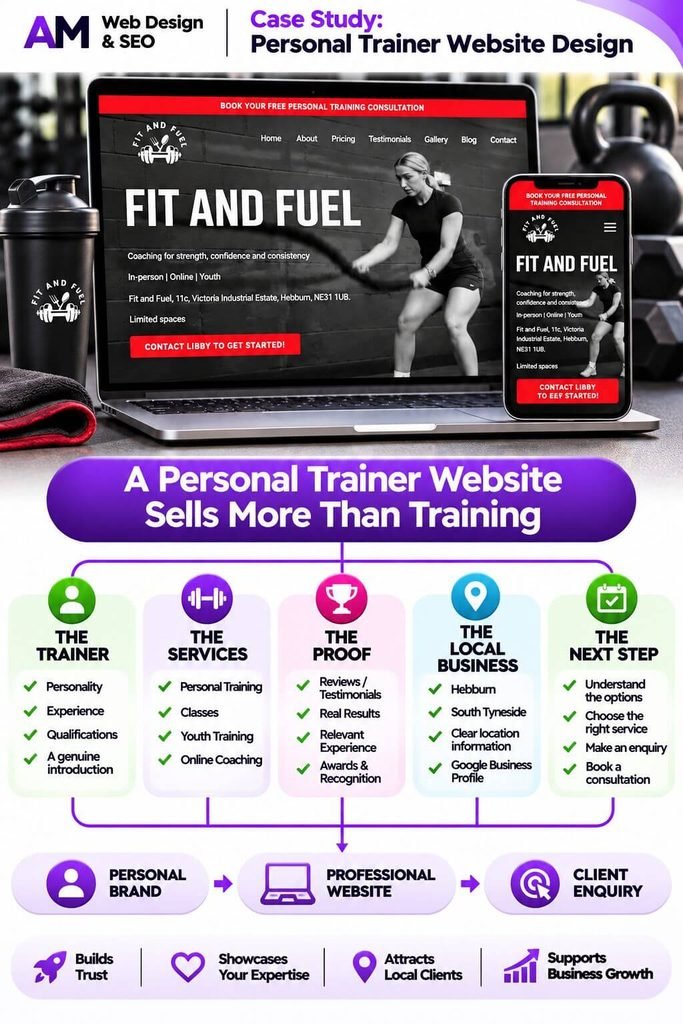
That means a personal trainer website should answer five important questions:
WHO ARE YOU?
Show the trainer behind the business.
WHAT DO YOU OFFER?
Explain the training options clearly.
WHO IS IT FOR?
Help potential clients recognise whether the service fits them.
WHY SHOULD I TRUST YOU?
Use genuine experience, qualifications, reviews and evidence.
HOW DO I GET STARTED?
Provide a simple next step.
The website can then support that foundation with local search, Google Business Profile and useful content.
Does Your Personal Training Business Need A Better Website?
The right website depends on how your fitness business operates.
A trainer with a small number of straightforward services may only need my Essential Website Design package.
A growing gym or personal training business with several services, classes and customer groups may be better suited to Business Website Design.
If you already have a website but aren’t sure whether it actually needs replacing, my Website MOT provides a personal review, written report and prioritised action plan for £197.
The website should fit the business rather than forcing the business into a standard website package.
Frequently Asked Questions About Personal Trainer Website Design
What should a personal trainer website include?
A personal trainer website should introduce the trainer, explain the training services available, show relevant qualifications and experience, establish where training takes place and provide a clear way for potential clients to make contact.
Genuine photographs and client feedback can also help build trust.
Does a personal trainer need a website if they use social media?
A website and social media do different jobs.
Social platforms can help people encounter the trainer and see ongoing activity, while the website provides a more permanent place to explain services, qualifications, training options and how to get started.
The website is also an online asset the business controls.
Should personal trainers show their prices on their website?
There isn’t one correct answer.
If training packages and prices are straightforward, publishing them can help potential clients understand the options before enquiring.
If programmes are individually tailored, the website may instead explain the process and encourage the visitor to have a conversation.
Is local SEO useful for personal trainers?
Yes, particularly for trainers providing in-person sessions.
Potential clients often need somebody within a practical travelling distance, so clear services, location information and a well-managed Google Business Profile can support local visibility.
Should a personal trainer website have separate pages for different services?
Important services can benefit from dedicated pages where they serve different customer needs.
For example, personal training, online coaching and youth strength and conditioning may involve very different customers and questions.
The website structure should reflect the real business rather than creating extra pages purely for SEO.