

Dramanon provides immersive experiences, creative learning and specialist activities for schools, organisations and other groups. This website redesign case study shows how an established business website can be improved without automatically throwing away everything that already exists and starting again.
When a business has been operating online for some time, its website often contains a mixture of valuable content, older pages, changing services and design decisions made at different stages of the company’s development.
That creates a very different challenge from building a website for a new business.
With Dramanon, the starting point wasn’t simply: “What should the new website look like?”
The more useful questions were:
What is already working?
What needs improving?
What should be rebuilt?
What is no longer needed?
That approach became the foundation of the project.
Project Overview
Client: Dramanon
Sector: Immersive Experiences, Education & Creative Learning
Project: Website Redesign & Rebuild
Services: Website Redesign, Website Structure, Content Development and Mobile Design
Website: Visit the Dramanon website
The Website Redesign Case Study Challenge
Dramanon already had an established online presence.
That meant this website redesign case study wasn’t about creating a website from an empty page.
There was existing content to consider, established services to present and information that still had value.
At the same time, the business and what it offered had continued to develop.
This is a common problem for established businesses.
A website can begin with a perfectly reasonable structure, but new pages and services are gradually added over several years.
Eventually the website no longer represents the business as clearly as it once did.
The answer isn’t necessarily to delete everything.
The challenge is working out what deserves to survive the redesign.
Why Established Websites Become Difficult To Manage
Websites rarely become outdated overnight.
It usually happens gradually.
A new service is added.
Another page is created.
A section is changed.
A new audience becomes important.
The business develops but the original website structure remains largely the same.
Eventually there can be a disconnect between the company that exists today and the website that represents it.
This doesn’t necessarily mean the existing website was badly built.
It may simply have been designed for an earlier version of the business.
That’s why I approach an established website differently from a completely new project.
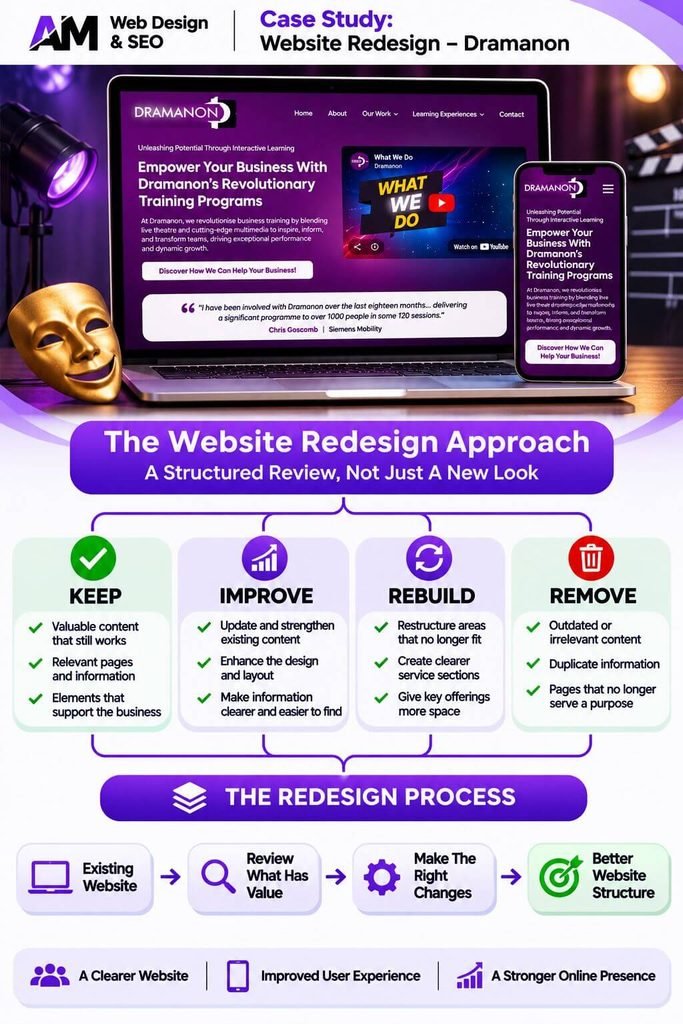
KEEP, IMPROVE, REBUILD OR REMOVE
The approach I use for a website redesign can be summarised in four decisions:
KEEP
Some existing pages, information or ideas may still work perfectly well.
There is no benefit in changing something simply so the redesigned website feels completely new.
IMPROVE
Useful content may still be relevant but need clearer writing, a better layout, stronger navigation or improved presentation.
REBUILD
Some parts of the website may need a more substantial rethink because the existing structure no longer reflects the business.
REMOVE
Old, duplicated or no-longer-relevant information can make a website more difficult to navigate and maintain.
This prevents a redesign from becoming change for the sake of change.
Reviewing The Existing Website Before Redesigning It
One of the most important stages in this website redesign case study was understanding the existing website before deciding what the replacement should look like.
That means looking beyond colours and layouts.
I want to understand:
- What services does the website currently explain?
- Which pages still have a genuine purpose?
- Has the business changed since those pages were created?
- Is useful information difficult to find?
- Are different audiences being sent through the same journey?
- Does the navigation still reflect the business?
- Are there pages worth retaining?
- Is content duplicated or outdated?
- Does the website work properly on mobile?
- What should a potential customer do next?
Only after those questions have been considered does it make sense to decide how the redesigned website should be structured.
For a business unsure whether its website needs a complete rebuild, my Website MOT uses a similar principle: look at what is actually happening first, then decide what needs attention.
Redesigning Around The Business As It Exists Today
A redesign provides an opportunity to look at the business again rather than simply transferring old pages into a newer design.
For Dramanon, the website needed to accommodate different parts of the organisation and the experiences it provides.
That includes specialist offerings such as its immersive 360° Igloo experiences as well as areas such as the Dramanon Academy.
These aren’t simply different paragraphs on the same page.
They represent different reasons somebody might visit the website.
The structure therefore needs to help visitors identify the part of Dramanon that is relevant to them and move towards appropriate information.
This is one of the main reasons website structure matters.
A visually impressive homepage can’t compensate for a website where visitors struggle to understand where to go next.
Improving The Website Content During The Redesign
A website redesign is also an opportunity to review the words.
Simply copying every paragraph from the old website into a new template can carry many of the original problems into the replacement.
Existing content may still contain useful information, but that doesn’t mean it should always remain unchanged.
Some sections may need expanding.
Others may be simplified.
Important services may need dedicated content.
Older information may no longer reflect how the business operates.
Headings and page structure may need improving so visitors can scan the information more easily.
This is where website content writing becomes part of the redesign process rather than a completely separate task.
Design and content need to work together.
Creating Clearer Routes Through A More Complex Business
Some businesses are easy to explain in a single sentence.
Others aren’t.
Dramanon has different experiences, audiences and areas of activity, which makes navigation particularly important.
A visitor interested in one part of the business shouldn’t have to understand every other part before finding the information they need.
The redesigned structure therefore needs to act as a guide.
The homepage introduces the business.
The navigation separates important areas.
Individual pages provide more detail.
Relevant pages connect with one another.
Contact and enquiry routes appear where they make sense.
This sounds simple, but it is one of the areas where established websites can become increasingly complicated as new information is added over time.
A redesign provides an opportunity to simplify that journey again.
A Website Redesign Case Study Focused On Mobile Use
An older website may still function on a mobile phone without providing a particularly good mobile experience.
Those aren’t the same thing.
A successful website redesign case study therefore needs to consider mobile visitors from the beginning.
That includes:
- Navigation that remains manageable on a smaller screen
- Headings that don’t overwhelm the display
- Text that is comfortable to read
- Images that scale properly
- Buttons that are easy to use
- Clear spacing between sections
- Contact routes that remain obvious
- Pages that don’t rely on desktop-only layouts
For a content-rich website, this becomes particularly important.
The more information a website contains, the more carefully the mobile hierarchy needs to be planned.
Protecting Useful Website Content
One of the biggest mistakes that can be made during a website redesign is assuming that every old page can simply disappear.
An established website may already contain pages that customers use, pages that have been shared elsewhere and URLs that search engines know about.
Changing a design doesn’t automatically mean all of those URLs should change as well.
Where useful pages can be retained, keeping established URLs may make sense.
Where a page genuinely needs to move or disappear, appropriate redirects can be considered.
The exact approach depends on the website, but the important principle is simple:
Don’t destroy useful website history just because the design is changing.
This is one of the reasons I see redesign work as different from simply installing a new theme.
Search Visibility During A Website Redesign
Search optimisation also needs to be considered while a website is being rebuilt.
The objective isn’t to freeze the old website forever because changing anything feels risky.
It’s to understand what has value before making changes.
That can include looking at:
- Existing page topics
- Page titles and headings
- Internal links
- Service content
- Useful URLs
- Duplicate or weak content
- Navigation
- Location relevance where appropriate
- New content opportunities
A clearer website structure can provide a better foundation for future search visibility, but the transition from old to new should still be planned.
My broader Get Found Online approach starts with the same idea: the website, content and search presence need to support one another.
Using The Redesign To Strengthen Important Services
A redesign also creates an opportunity to give important parts of a business the attention they deserve.
For Dramanon, specialist areas such as the 360° Igloo and Academy need enough room to be understood in their own right.
This is preferable to adding increasingly large amounts of information to one generic services page.
Dedicated content allows an important service or area of the business to answer its own customer questions.
It can explain what the offering is.
It can show who it is for.
It can provide relevant imagery.
It can answer common questions.
And it can give the visitor an appropriate next step.
The purpose isn’t to create more pages for the sake of SEO.
It’s to give important parts of the business enough space to be useful.
Creating A Website That Is Easier To Develop
Another benefit of redesigning the structure is making future changes easier.
A business shouldn’t need another complete redesign every time it introduces something new.
A properly planned website should provide sensible places for new services, content and information to live.
That doesn’t mean predicting every possible thing the company might do over the next ten years.
It means avoiding a structure so rigid that every change becomes difficult.
This is particularly useful for businesses like Dramanon where the organisation can continue developing new experiences and areas of activity.
The website needs room to evolve with it.
The Finished Website Redesign
The finished Dramanon website gives the business a more current platform for presenting its different experiences and activities.
But the most important part of this website redesign case study isn’t simply that the new website looks different.
The redesign creates an opportunity to reconsider how the website represents the business.
Useful information can be retained.
Content can be improved.
Important areas can be given more space.
Navigation can become clearer.
Mobile presentation can be improved.
Older elements that no longer serve a purpose can be removed.
You can visit the Dramanon website to see how the business and its different areas of activity are presented on the current website.
What Can Other Businesses Learn From This Website Redesign Case Study?
The biggest lesson from the Dramanon project is that a website redesign shouldn’t automatically begin with:
“Let’s start again.”
A better starting point is:
“What do we already have?”
An existing website may contain years of useful information and established pages.
Some of it may be worth keeping.
Some may need improving.
Some may need rebuilding.
And some may genuinely be ready to disappear.
That is why I use the:
KEEP → IMPROVE → REBUILD → REMOVE
approach.
It creates a more considered redesign process and avoids changing things simply because they are old.
It also recognises something important about established businesses.
Your current website is part of your business history.
The job isn’t necessarily to erase that history.
It’s to build a better website for where the business is now and where it needs to go next.
Has Your Business Outgrown Its Current Website?
If your business has changed but your website hasn’t kept up, my Website Redesign & Rebuild service is designed around improving what you already have rather than automatically starting again.
If you aren’t sure whether you need a redesign, my Website MOT provides an independent review of the current website and a prioritised action plan before you commit to a larger project.
For a business that genuinely needs more space for services, audiences or content, the Advanced Website package may also be appropriate.
The right answer depends on what is already there and what the website needs to do next.
Frequently Asked Questions About Website Redesign
Should I redesign my website or build a completely new one?
It depends on what is wrong with the existing website.
If the underlying content and structure are still useful, a redesign may be able to retain significant parts of the website while improving its presentation and usability.
If the structure no longer reflects the business, more substantial rebuilding may be required.
Will I lose all of my existing content during a website redesign?
Not necessarily.
Useful existing content can often be retained, improved or reorganised.
A redesign is a good opportunity to review content rather than automatically deleting or copying everything.
Should my website URLs change during a redesign?
Not unless there is a good reason.
Existing URLs may already be known to customers and search engines. Where useful URLs can be retained, that can often be preferable.
Where URLs genuinely need to change, redirects can be considered as part of the migration.
Can a website redesign affect SEO?
Yes.
Changing URLs, removing pages, altering content and changing internal links can all affect how a website is understood by search engines.
That doesn’t mean websites shouldn’t be redesigned. It means existing search value should be considered during the process.
How do I know if my website needs redesigning?
Common signs include an outdated appearance, difficult mobile navigation, confusing website structure, services that no longer reflect the business, outdated content and difficulty adding new information.
If you aren’t sure what the real problems are, a website audit can help identify what should be addressed first.